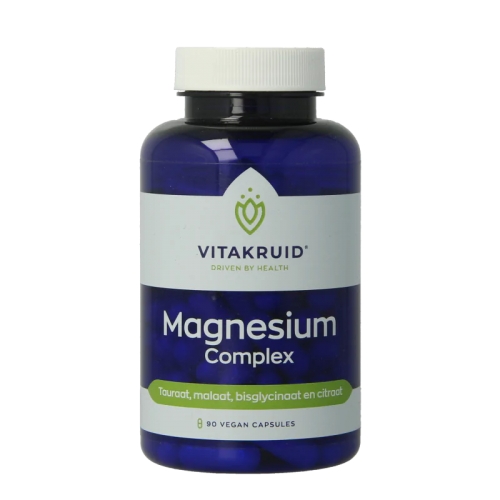
Vitakruid Magnesium complex
Magnesium in food
Magnesium is found in many different foods, but seeds in particular are very rich in this mineral. In addition, green vegetables, cereals, nuts, bananas and cocoa are also good sources. In the Netherlands, we get most of our magnesium from bread, rice, cereal products, dairy (substitutes) and other non-alcoholic drinks.
Food Per 100 grams
Hemp seeds 700 mg
Pumpkin seeds 535 mg
Cocoa powder 525 mg
Brazil nuts 410 mg
Sunflower Seeds 363 mg
Sesame Seeds 370 mg
Chia seed 335 mg
Magnesium Complex: four easily absorbable forms in one jar!
With Magnesium Complex, you get four easily absorbable forms of magnesium that we normally offer separately, now in one convenient supplement. This means you can enjoy the unique benefits of magnesium malate, taurate, bisglycinate and citrate. So you have a widely applicable supplement at home!
Magnesium forms with the best absorbency
We can divide the different forms of magnesium into two categories: organically and inorganically bound. The organic forms - such as magnesium malate, taurate, bisglycinate and citrate - are more bioavailable and better absorbed.
Optimal absorption through amino chelated forms
When magnesium is linked to an amino acid - as with magnesium taurate and magnesium malate - the mineral is better protected from gastric juices. These variants, known as amino-chelated magnesium forms, have a stronger structure that allows them to remain intact until they reach the intestines. This results in better absorption and less gastrointestinal discomfort compared to unchelated forms.
Taurate and bisglycinate
Magnesium bisglycinate and taurate are both organic, amino-chelated forms of magnesium. Magnesium bisglycinate consists of magnesium and two (bis) glycine molecules, while magnesium taurate is chelated with l-taurine, an amino acid-like substance.
When magnesium is bound to glycine or l-taurine, it can cross the blood-brain barrier more easily. As a result, these forms of magnesium are better absorbed into brain tissue.
Citrate and malate
Magnesium Complex also contains magnesium malate and citrate. Here, magnesium is bound to malic acid (malate) and citric acid (citrate). These acids are both part of the citric acid cycle, which provides energy to our cells. Moreover, these forms of magnesium are relatively well absorbed in muscle tissue.
Magnesium Complex contains B6 in the form of pyridoxal-5-phosphate (P-5-P). This form has better bioavailability, and is the safest form of vitamin B6.
Magnesium Complex capsules for ease of swallowing
Some found the Magnesium 200 Complex tablets too big and difficult to swallow. Therefore, we now offer the same product in capsule form. These capsules contain the same high-quality ingredients as the tablets, but are much easier to swallow thanks to their smaller size.
Vitamin B6 as pyridoxal-5-phosphate:
Vitamin B6 has been added to the formula to support the action of magnesium.
This is because the vitamin contributes to proper energy supply in the muscles and activates the body's natural energy.
It also benefits mental balance and concentration.
- Magnesium plays a role in bone formation and maintaining strong bones.
- Magnesium benefits brain function, mood, the cell division process, memory, learning performance and concentration.
- Magnesium helps maintain normal protein synthesis, proper electrolyte balance and normal energy-yielding metabolism.
- Magnesium is important for strong teeth.
- Magnesium is good for muscles and the nervous system.
- Magnesium is beneficial in reducing fatigue and lethargy.
- Vitamin B6 is good for red blood cell production, protein production and cysteine production, among other things.
Packaging: 90 capsules
Notification Number: NUT AS 4226/97
Magnesium taurate, L-taurine, Magnesium citrate, magnesium bisglycinate, magnesium malate, stearic acid (anti-caking agent), HPMC (capsule), Vitamin B6 (pyridoxal-5-phosphate).
Take 1 to 3 capsules per day. Adhere to the recommended dosage.
Not suitable for children under 3 years of age.